
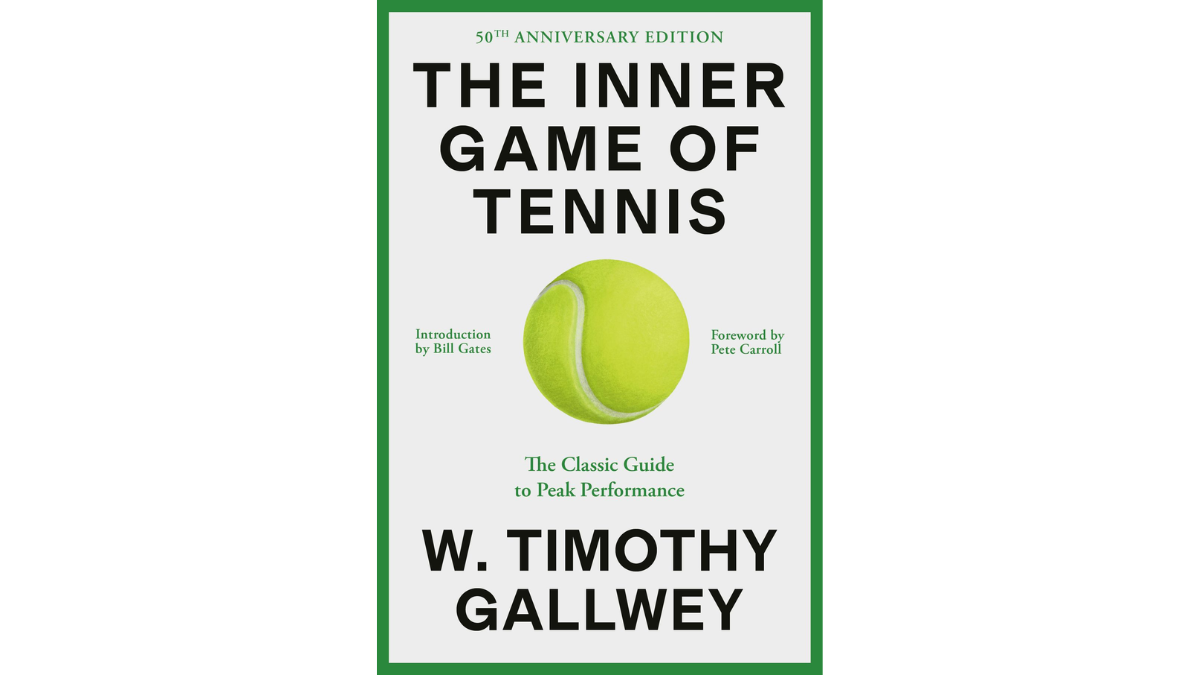
✒️ First Principle in 3 Sentences
Every game consists of an Outer Game performed by Self 2 (the intuitive “doer”) and an Inner Game played by Self 1 (the verbal “teller”). When Self 1 interferes with judgment, ego, or over-instruction, it creates friction that restricts Self 2’s natural physical performance. To excel, we must train ourselves to quiet the “teller” and focus on the “doer” using sensory awareness and child-like imagination.
🔖 My Favorite Quotes
- “Letting go of judgments does not mean ignoring errors. It simply means seeing events as they are and not adding anything to them.”
- “He had learned, but had he been “taught”? This question fascinated me.”
- “What does it mean to win the Inner Game? A few years ago, I might have tried to answer this question. Now I choose not to—even though I think it is the most important question. Any attempt to define an answer to this question is an invitation to Self 1 to form a misconception.”
🏃🏻➡️ How It Changed My Action
The consistency in the game of publishing, whether it’s internal sales enablement or social media, isn’t about the validation of the people, but the inner focus we maintain.
When I put my name on something, Self 1 naturally becomes sensitive by attaching our identity to the performance. But the key is to decouple the two: I am not my presentation, and I am not my slide deck.
Any feedback is an observation and non-judgmental.
- Focus on the metrics: click rate, impression, CTR.
- Focus on the context: slide page, feedback, the sentence in the slide, the click in the demo.
This skill is also critical when coaching junior members who often get trapped in the perfect performance. Remind them to move past the expectations of a “bad” session and instead picturing a desired outcome. This helps them to stay focus on their action.
📔 Summary & Highlights
Self 1 vs. Self 2
This structure defines the “Who” behind the Inner Game and the fundamental roles of the Teller and the Doer.
- The Roles: “For clarity let’s call the ‘teller’ Self 1 and the ‘doer’ Self 2.”
- The Conflict: “It is Self 1’s mistrust of Self 2 which causes both the interference called ‘trying too hard’ and that of too much self-instruction.”
- The Goal: “The concentrated mind has no room for thinking about how well the body is doing… the ability to approach this state is the goal of the Inner Game.”
- Trust as the Bridge: “Trusting your body in tennis means letting your body hit the ball. The key word is let.”
The Problem: Judgment is an Interference
- The Definition: “What I mean by judgment is the act of assigning a negative or positive value to an event.”
- The Result of Judgment: “It is the initial act of judgment which provokes a thinking process… adding anything to [events].”
- The Standard Trap: “Uncomfortable without a standard for right and wrong, the judgmental mind makes up standards of its own.”
- The Rose Analogy: “The rose is a rose from the time it is a seed to the time it dies.” (Acceptance of the current state without labels).
How To Focus On Doing?
This structure outlines the “Low-Friction” methods for communicating with Self 2 and staying in the present.
- The Native Tongue: “The native tongue of Self 2 is imagery: sensory images. Movements are learned through visual and feeling images.”
- The Bounce-Hit System: “Say the word bounce out loud the instant you see the ball hit… the mind is so absorbed in watching the pattern that it forgets to try too hard.”
- Breath: “What is more here and now than one’s breathing? … observing my breath going in, going out in its natural rhythm.”
- Outcome-Based Instructions (Imagination): “If you wish the ball to go to the crosscourt corner, you simply imagine the necessary path of the ball to the target. Do not try to correct for past errors.”
Is There A Win?
This structure focuses on the philosophy of long-term growth and avoiding the trap of “Perfect-o.”
- Continuous Improvement: “My model is always being destroyed and rebuilt as I learn more and more. My technique is always evolving.”
- Breaking Habits: “A child doesn’t dig his way out of his old grooves; he simply starts new ones!”
- The Trap of Validation: “Self 1 gets so dependent upon things, situations, people, and concepts… that when change occurs… it feels threatened.”
- The Definition of Winning: “Winning is overcoming obstacles to reach a goal, but the value in winning is only as great as the value of the goal reached.”